
Identify a Logan County Property Owner
A short chain of official records does the work. The Logan County Appraiser ties an address to ownership on a Property Record Card. The Logan County Register of Deeds keeps the conveyance records that may carry a newer grantee. When the same land description lines up in both places, the ownership answer is far more solid than any broad name search can give. Check the Appraiser first for the parcel. Check the Register last for the freshest deed.
- Start with the situs address, the physical address assigned to the taxable parcel.
- Ask the Appraiser for the matching PRC, owner field, parcel identifier, and legal description.
- Use that owner and legal description to locate the newest deed or correction deed at the Register.
- Read the grantee, recording date, deed type, and land description, then check for a later instrument.
- If the vesting name is an entity, trust, or estate, identify the name exactly before following its separate record trail.
Dates matter at every step. The Property Record Card reflects one assessment roll, while the recorder's index reflects its own filing date, so a name without a date cannot tell you which source is newer.
Ask Logan Appraiser by Address
The Appraiser's official page describes ownership by address as public information available by phone. Staff can also share the appraised value, building details, acres taxed or lot size, and square footage. A Property Record Card lists the owner, land description, acreage or square feet, and building information. Callers can use those facts to confirm the address really points to the intended parcel. Reach the office at 785-671-4821 or visit 710 W. 2nd Street in Oakley during its posted weekday hours. Give the full address, the postal city, and any parcel number or legal-description clue. Ask which assessment year the owner field represents.
The official Logan County Appraiser page is the source for that ownership-by-address service:
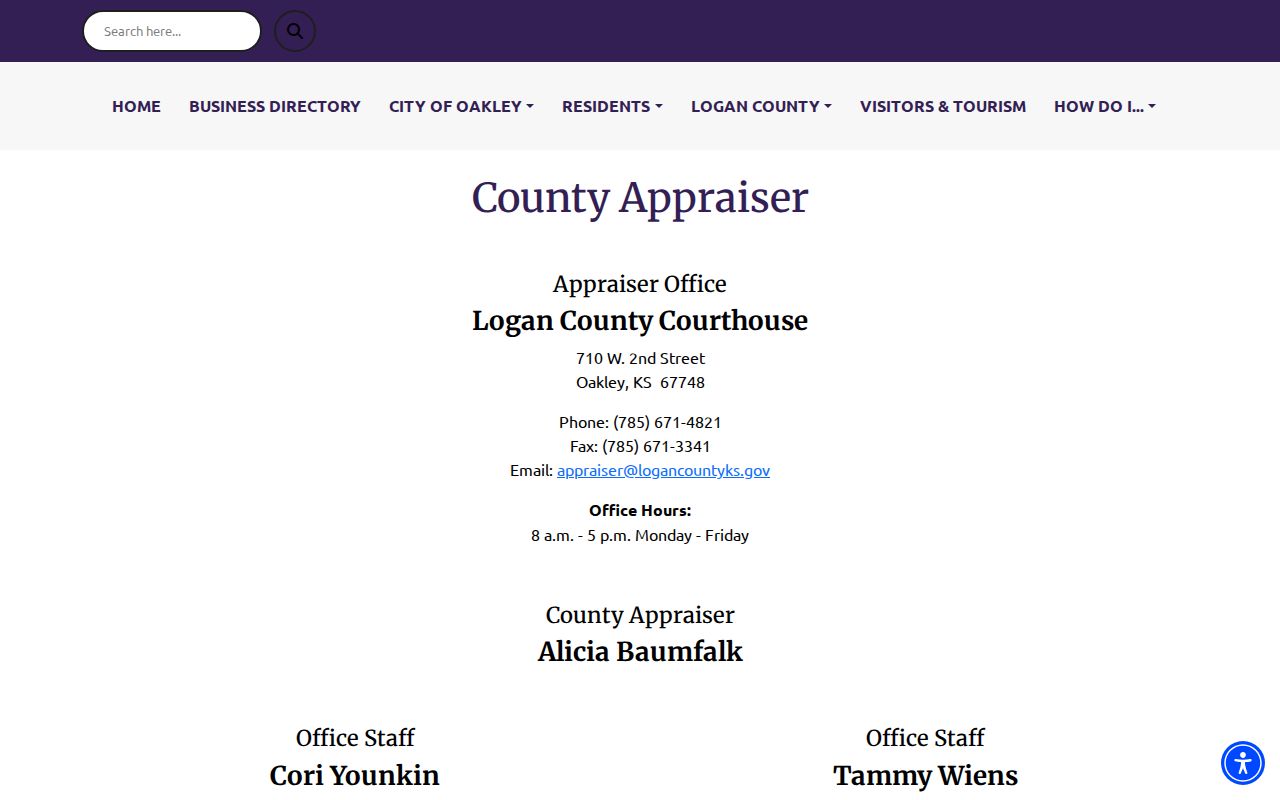
One warning on that page deserves weight: for the most current owner of record, the Appraiser's own guidance sends researchers to the Register of Deeds.
Where Logan County Ownership Appears
No single record answers every ownership question in Logan County. Assessment, recording, entity, and map records each serve a different purpose and update on different schedules, so a side-by-side comparison keeps the address-to-owner method honest.
| Ownership source | What the source contributes | Access route |
|---|---|---|
| Appraiser PRC | Ownership field, land description, area and building facts for an assessment year | Phone, counter, purchased PRC or GIS map |
| Register index and deed | Recorded grantee, filing date, legal description and deed type | Courthouse counter; live online index not verified |
| Kansas business search | Legal entity name, status, business ID, resident agent and filings | Free statewide web search |
| GIS or plat | Spatial and lot context for matching the land | Appraiser map, recorded plat or Kansas GIS discovery |
Some terms need separating first. An owner of record is simply a name. It is the name an official roll or index carries for its stated date. Vesting describes the form of title placed in the grantee. The grantee is whoever receives an interest under a deed. None of these labels means the named party actually occupies the property.
Register Confirms Logan County Ownership
The county's own instruction is blunt: the Register of Deeds holds the most current ownership of record. A deed can be filed weeks before the annual appraiser roll shows the transfer. So the recorder often leads. Search the newest relevant instrument by grantee and grantor. Then compare its Logan County land description against the parcel the Appraiser identified.
The Register's holdings run wide. Deeds sit alongside mortgages, liens, oil-and-gas leases, plats, powers of attorney, UCC filings, and corporation records. Each has its own index. Read any deed together with correction deeds and later transfers. Mortgage releases and liens shape the broader land record. But they do not name a new fee owner by themselves.
The county publishes no verified online deed index. So the counter and the phone line at 785-671-4224 remain the core access channels. Ask whether staff can search by grantor, grantee, legal description, book and page, or instrument number. Request the current copy procedure too.
Note: An absent online hit does not mean a Logan County ownership record is missing from the recorder's index.
Match Logan Owner and Land
Common names invite false matches. Hold onto spouse or co-owner names and middle initials. Keep instrument dates, deed types, and legal descriptions handy as you compare records. In Oakley, addition names from the original plats help separate parcels. O'Hara's 1909 Addition, Glick's Addition, and Roemer subdivision are examples. Rural property leans more on section, township, range, and other recorded land wording. Street addresses matter less there.
Situs and mailing addresses do different jobs. The situs address points to the parcel itself. The mailing address receives notices. It may be a post office box or a home outside Logan County entirely. An owner's mail address is not proof of residence. A postal city never proves the land sits inside city limits.
- Situs address
- The physical address used to locate the taxable property.
- Mailing address
- The place where the county sends owner or tax correspondence.
- Legal description
- The recorded words that identify the land, often more durable than a street number.
- Recording lag
- The period between a transfer, filing, and an update to another county record.
Read Logan LLC and Trust Owners
The grantee may be a company. Copy its exact legal name and Kansas business ID. Do not guess at the person behind it. The Kansas Secretary of State business search accepts a business name, a Kansas business ID, or a resident-agent name. Name searches support Contains or Starts With matching. Results cap at the first 200 hits.
An entity detail page can show status, registered agent, addresses, annual reports, merggers, and dissolution filings. Treat these as entity facts only. The resident agent is not automatically the Logan County property owner. No officer or contact replaces the grantee named in the recorded deed.
Trusts demand the same discipline. A deed may vest title in a trustee or cite a certificate of trust. Estate ownership can involve an executor, administrator, transfer-on-death instrument, affidavit, or probate case. Follow the exact vesting phrase. Then check the recorded legal description before deciding who truly owns the interest.
Use KORA for Logan Records
Kansas open-records law gives you a written fallback. Under K.S.A. 45-218, any person may inspect nonexempt public records during regular agency hours. The office must respond as soon as possible. It must do so no later than the end of the third business day, or explain any delay or denial. Reasonable actual costs can be charged for copies under K.S.A. 45-219.
Direct the request to whichever office keeps the record. List the address and parcel or legal description. Add the owner name if known, the record type, and the date range. Ask to inspect first, then say whether you want an ordinary or certified copy. The County Clerk routes county open-records requests. The Register and Appraiser stay the subject custodians. A few items stay closed. Military discharges and Sales Validation Questionnaires are not open. Ask for the segregable public portion instead of protected personal identifiers.
When Logan Owner Search Is Offline
A failed web search does not mean no ownership record exists. Logan County publishes no confirmed assessor or GIS property search tool right now. The county's former GIS address no longer resolves. So work the fallback chain. Call or visit the County Appraiser first, then the Register of Deeds. A focused KORA request works when phone and counter fail. Historic research through the Kansas Historical Society or the Oakley library helps when an old address or vanished townsite is involved.
One quirk of Logan County history matters for older deed records. The county seat moved from Russell Springs to Oakley in 1963. Documents from before the move may still point to Russell Springs as a place clue. Even so, custody now sits at the Oakley courthouse. Search under both names in historic catalogs and notices. Send any current records request to the custodian at Oakley.
For the present owner of record in more depth, the Logan County current owner page stays focused. That single question is its whole job. Tracing earlier owners is a different job. That kind of property search begins with deed history, not the current tax roll.
Limits on Logan County Owner Lookups
Ownership is not the same as residency. Knowing who owns a property in Logan County is not the same as knowing who lives there. A tax roll can list an owner whose mailing address is in another state. A trust or business name can stand where a person's name was expected. Recent filings, unrecorded interests, and estate disputes can each muddy the trail. Pending corrections can muddy it too. A deed or parcel number only seems to promise a clean answer.
Lawful use. Owner records support purchase checks, estate research, boundary questions, and civic review. Kansas law does not permit stalking, harassment, or prohibited solicitation from public-record name and address lists.
Kansas law also limits how you use what you find. K.S.A. 21-5427 addresses stalking, and K.S.A. 45-230 restricts certain solicitation uses of names and addresses drawn from public records. Safe at Home gives eligible survivors a substitute address with mail forwarding. Public access is never permission to target a person. A protected address must never be republished.
Remember that an owner name is not a title opinion. The assessor's tax roll is evidence. The recorder's deed index is evidence too. So is the deed itself. Each carries its own dates and limits. Competing claims and the legal effect of any instrument belong with a title professional or attorney.