
Begin a Logan County Property Records Search
Start with whatever clue you hold. An address, owner name, or legal description can point you toward a Property Record Card, or PRC. That search runs through the Logan County Appraiser. The card links the address to a land description. It also covers acreage or square feet, ownership, building facts, and appraised value. The live search form's parcel-number format is unclear, though. A phone or counter request is the dependable route while the old portal is down.
Take the owner name and legal description to the Register of Deeds. There you can pull the newest deed and any recorded encumbrances. Then check the treasurer's tax account and any map data. These records supply evidence. No single entry proves clear title, fixes a legal boundary, or replaces a professional appraisal.
- Give the Appraiser the situs address, owner name, or legal description and request the PRC.
- Note the exact owner spelling, parcel reference, acreage, and full land description.
- Ask the Register of Deeds for the newest deed and any mortgage, release, lien, easement, or lease indexed to the tract.
- Match the parcel against the treasurer's account and available DASC or plat references.
- Request a plain or certified copy directly from the office that keeps the source record.
Offices Behind Logan County Property Records
Real-estate records live at the Logan County Courthouse in Oakley, split among three offices. The Register of Deeds holds recorded land instruments. Those documents are the most current evidence of ownership. The Appraiser keeps the assessment roll and sells PRCs and GIS maps. The Treasurer turns the certified roll into tax statements, collects payments, and handles delinquency questions. All three offices open at 8 a.m. They close at 5 p.m., Monday through Friday.
Read the Logan County Property Record Card
The Appraiser's public description of a PRC confirms four core groups of facts: land description, acreage or square feet, ownership, and building information. Those fields make the card the best bridge from a street address to the identifiers used elsewhere. Appraised value is set as of January 1, and change-of-value notices are due by March 31. The office can answer public questions by phone and offers map or PRC copies, but it does not perform abstract work, locate property lines, or conduct comparable-sale research for the public.
| Ownership | Name carried on the assessment roll and mailing information |
|---|---|
| Land | Legal description, acreage, or square feet |
| Improvements | Available building characteristics |
| Value | Annual appraised and assessed information |
The official Appraiser page shows the county access point for parcel-card questions.
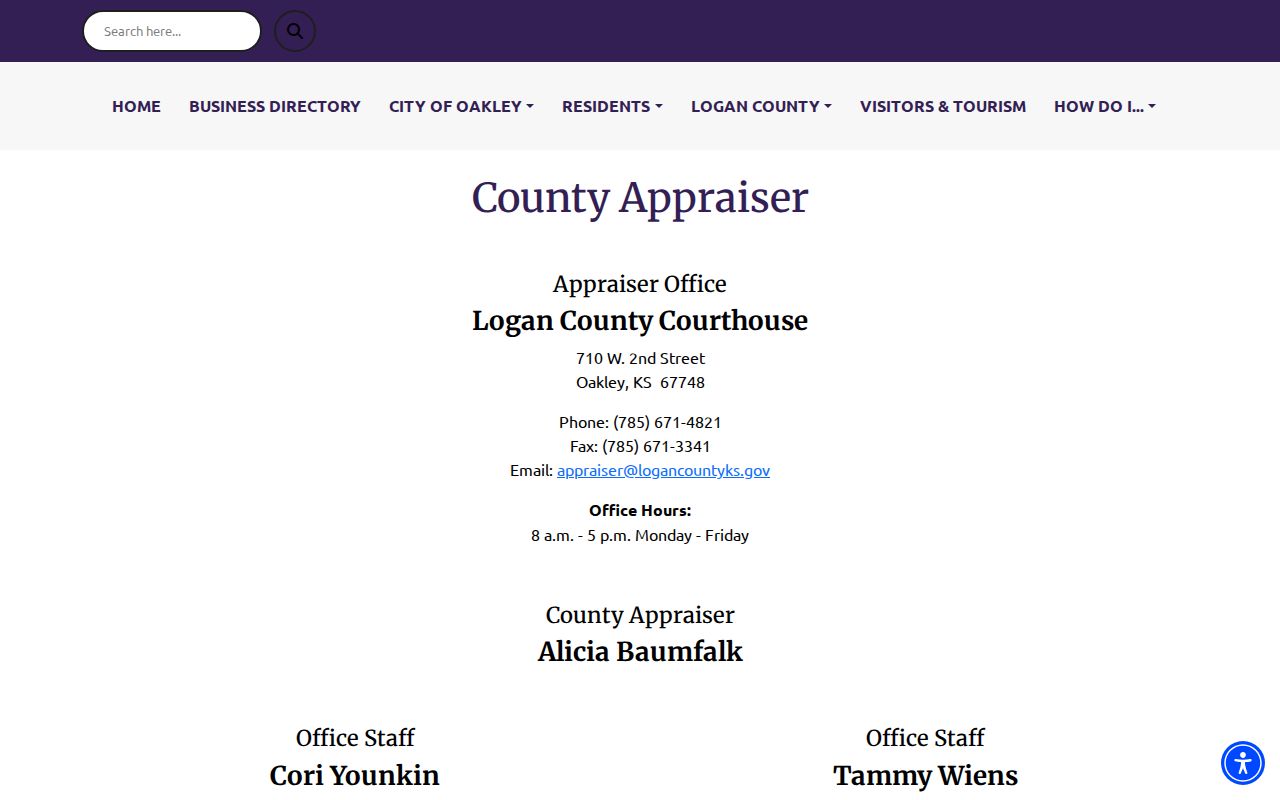
The Appraiser's own office page shows why a direct request still matters while the former property portal is offline. Note: The Appraiser sends researchers to the Register of Deeds for the most current owner of record.
When Logan County's Online Search Is Absent
The old Logan County GIS and property address, logan.kansasgis.com, does not resolve. The county publishes no current official deed-index URL, cutoff year, or live assessor form online. That is an access gap, not proof a deed or parcel record is missing. Call the Appraiser or Register first. Or visit the courthouse counter. A focused written request works too. Give names, approximate dates, the legal description, and the document type.
Statewide tools still help. The Kansas Data Access and Support Center and the Kansas Geoportal Hub serve as official discovery points for map data. The Kansas Historical Society's Logan County resources can point to older deed books, newspapers, and county history leads. Under KORA, the agency must respond as soon as possible and by the end of the third business day. It must also explain any delay or denial.
Portal myth. An empty or broken website is not an empty courthouse. Ask the custodian to search its local index and paper holdings.
Which Logan County Record Answers
No single county file holds a tract's full history. A deed documents a conveyance. A PRC describes the assessment unit, and a tax account tracks the bill. A plat supplies recorded lot context. A civil case may explain a foreclosure, quiet-title order, or lien dispute. Search by purpose, then cross-check the common owner and legal description.
| Record Type | What It Documents | Kept By | Access |
|---|---|---|---|
| Deeds and leases | Transfers, reservations, surface and mineral interests | Register of Deeds | Counter, phone, mail, or records request |
| Mortgages, releases, liens | Recorded claims and later satisfactions | Register of Deeds | Index and document-copy request |
| Assessment and PRC | Ownership, land, improvements, appraised value | County Appraiser | Phone, counter, purchased PRC |
| Tax account | Statement, payment, and delinquency status | County Treasurer | Office and state payment interface |
| Plat and GIS reference | Lots, blocks, parcel context, map layers | Register and GIS sources | Recorded plat, office map, state GIS catalogs |
| Property litigation | Foreclosure, quiet title, probate, court liens | District Court | CaseSearch, terminal, clerk request |
Use the deed file for the recorded transfer and the appraiser card for the assessed parcel. The fuller Logan County deed records guide explains instruments and index direction. Tax and mapping pages keep their own focus.
Logan County Deeds, Mortgages, and Oil-and-Gas Records
The Register of Deeds indexes deeds, correction deeds, mortgages, releases, liens, easements, plats, oil-and-gas leases, UCC filings, corporation records, and powers of attorney. That mix matters in western Kansas. A surface ownership question may also need a lease, assignment, or release affecting subsurface interests. The county keeps real-estate records open. Military discharges and Sales Validation Questionnaires are the exceptions.
A good request names the grantor or grantee and an approximate recording date. It should also give the document type. Add the legal description when known. The office publishes no working public portal or online cutoff. Confirm image and copy options by calling 785-671-4224. A recorded document is indexed evidence, but recording alone is not a title opinion.
Logan County Values and Tax Dates
Kansas law sets the appraisal date each year on January 1. That means every parcel in Logan County gets a fresh value. The fresh value arrives before the tax year even begins. The Kansas Property Valuation Division publishes guidance on notices and appeal rights. It also covers CAMA data, ratios, and statewide statistics. Parcel-specific details still come from the county. Fair market value is the general standard, but class-specific assessment rates apply. Appraised value, assessed value, taxable value, and a sale price are therefore not interchangeable terms.
The Treasurer mails tax statements in November. First-half taxes are due December 20. Second-half taxes are due May 10, and no separate stub goes out for that deadline. The Kansas property-tax payment interface needs your county choice and statement information. For levies and tax-unit boundaries, the County Clerk prepares the tax roll. The Clerk also computes mill levies and adds special assessments. The Clerk certifies the tax-unit maps.
Logan County Parcel Maps Need Verification
Logan County's old parcel viewer is unavailable. A parcel-map search should therefore combine the Appraiser's purchasable GIS map, a recorded plat from the Register, and state GIS discovery. DASC and the Geoportal Hub may offer imagery, administrative boundaries, roads, and downloadable data. They may not carry a current Logan-specific layer list. They may not carry an adjacent-parcel tool. One caution: a statewide map is never the county assessment roll.
- Parcel
- An assessment and mapping unit, not automatic proof of a surveyed boundary.
- Plat
- A recorded map of lots, blocks, streets, and related dedications.
- Legal description
- The land wording that remains more stable than a mailing or situs address.
Note: A GIS line is only a search aid, and just a deed, plat, survey, and applicable law can settle a legal boundary question.
Property Cases in Logan County's District Court
A property records certificate tells only part of the story. Foreclosure, quiet-title, probate, and lien disputes can surface facts that never appear on a PRC. Logan County District Court sits in the 15th Judicial District. Its clerk keeps office at the Oakley courthouse. Start with Kansas CaseSearch, which replaced the older public portal. Some documents are closed to guest users. Use a courthouse terminal or a clerk request for those.
Search by party name or case number. Then note the case type, filing date, party roles, register of actions, and any available documents. Carry every legal description, sheriff's deed reference, probate order, or judgment back to the land-record index. Federal property litigation belongs in the U.S. District Court for Kansas and PACER, not the county portal.
Logan County.s 1963 Records Move
Logan County was organized in 1887. Russell Springs held the county seat until a close vote and litigation moved it to Oakley. The records themselves made the trip on August 13, 1963. The present courthouse was completed in 1965. The old Russell Springs courthouse now belongs with the Butterfield Trail Museum story. The practical payoff: an older deed, probate file, newspaper notice, or assessment book may carry a Russell Springs label. Even so, today's copy request goes to Oakley.
| 1887 | County organized; Russell Springs county-seat era begins |
|---|---|
| August 13, 1963 | County records moved to Oakley |
| 1965 | Current Logan County Courthouse completed |
For an older chain of title, keep both town names in your notes. Ask whether the volume you need still sits in the courthouse or holds a Kansas Historical Society microfilm or catalog counterpart.
Oakley, Winona, and Russell Springs Record Clues
The 2020 incorporated-place roster counted Oakley at 2,046 residents. Winona came in at 193, and Russell Springs at 26. Those figures are context, not parcel counts. Oakley serves as the courthouse and permit center. Winona can overlap a broader Western or Winona Township context. Russell Springs carries the old county-seat and Pioneer Town Site Company history. A postal city never settles municipal boundaries, though.
Historic names can be decisive in a Logan County property search. Oakley records may cite the original plat, O'Hara's 1909 Addition, Glick's Addition, or Roemer subdivision. Winona began with D.D. Hoag and the Western Town Site Company in May 1886. Russell Springs was founded through the Pioneer Town Site Company in December 1886. Preserve the exact addition, townsite, lot, block, section, township, and range wording. The deed and plat can then connect it to a modern address.
Oakley Permits Add a Property-History Layer
Inside Oakley, a city permit can document work the deed index never describes. The Oakley building-permit page covers fences, garages, sheds, signs, and moving buildings or sheds. It also covers underground sprinkler systems. Siding needs no permit. Underground sprinklers require three inspections. The city also states that it does not locate private property lines.
Treat a permit as a house-history clue, not proof of ownership or boundary. Ask the city for the address, applicant or owner name, and project type. Also request the approximate date, permit status, and any inspection records. Then match that permit to the county PRC and its legal description.
Limits of Logan County Property Records
Public land files can show the owner carried on a roll. They also show recorded transfers, known encumbrances, parcel characteristics, appraised values, taxes, and mapped context. They cannot do everything. They do not establish who occupies a home, and they do not guarantee that every interest has been found. They will not mark a surveyed line on the ground, or predict a sale price. Restricted records stay restricted, including military discharges and Sales Validation Questionnaires at the Register.
KORA opens public records during regular agency hours and allows actual-cost fees. Statutory exceptions still apply. Kansas Safe at Home gives eligible survivors a substitute address and mail forwarding across public agencies. It does not erase the underlying record. Use official sources for a defined property purpose. Verify any consequential result with its custodian.
Lawful use. Logan County property records support due diligence, boundary research, tax review, and civic transparency. They must never be used to stalk, harass, or harm a person.